
Neuroarchitecture – the spaces that shape us
¿What happens to your brain every time you walk through a doorway ?

We have always believed that a space is not neutral. Long before learning the word «neuroarchitecture,» we perceived it instinctively: there are spaces that invite you to stay and others that push you toward the door without you knowing quite why. What we didn't know back then is that this feeling has a measurable biological explanation.
Neuroarchitecture is the discipline that studies how the built environment—the spaces we design, inhabit, and move through—directly affects our brain, our nervous system, and ultimately, our behavior and well-being. It sits at the intersection of architecture, neuroscience, and cognitive psychology, and is quietly transforming the way we understand design.
«Architecture has always shaped the human experience. Neuroarchitecture simply gives us the science to understand why.«
¿Where is it from?
The field has its formal roots in 2003, when a small group of neuroscientists and architects, including Nobel laureate Francis Crick and architect Jonas Salk, founded the Academy of Neuroscience for Architecture (ANFA) in San Diego. Its foundational premise was simple yet radical: The design of spaces must be based on how the brain actually works.
Before this, architecture relied heavily on aesthetic intuition and cultural tradition. Afterwards, something changed. Researchers began placing people inside brain scanners and measuring cortisol levels, heart rate variability, and eye-tracking responses to different spatial configurations. The data was revealing.
Photo: Salk Institute, San Diego, California, USA – Joe Richland

Scientific note
MRI neuroimaging studies have shown that the parahippocampal cortex, a region involved in memory and spatial navigation, responds significantly more to the architecture of curved shapes than to spaces dominated by right angles. This partly explains why spaces with high ceilings and fluid lines feel liberating, while low, angular rooms can generate subtle anxiety.
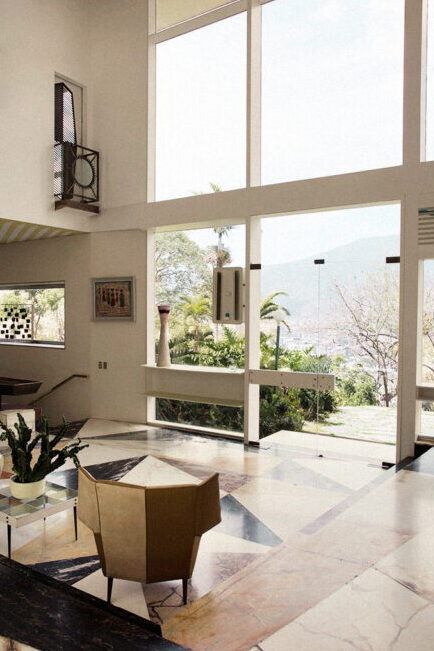
Every time we enter a new space, our brain performs a rapid and unconscious evaluation. It reads the ceiling height, the quality of the light, the acoustic texture, the warmth of the materials, the presence of nature, and the degree of enclosure, all in a matter of milliseconds. It is not a metaphor. It is measurable neural activity.
Natural light, for example, regulates the secretion of cortisol and melatonin, directly affecting our mood, level of alertness, and sleep quality. A workspace with abundant daylight and views of the outside not only feels better, but also measurably reduces stress hormones and increases cognitive performance. Multiple studies confirm this effect in hospitals, schools, and offices.
Biophilic elements like plants, water sounds, natural materials, and the fractals present in wood grain or stone activate our parasympathetic nervous system, the branch responsible for rest and recovery. Our brains evolved in natural environments over hundreds of thousands of years. The built world is, evolutionarily speaking, very recent. Our nervous system has not forgotten where we came from.
Photo: Villa Planchart, Caracas, Venezuela – Matthieu Salvaing
«When I design a room, I am not simply arranging walls. I am choreographing a neurological experience.»
¿Why this matters beyond hospitals?
It is tempting to think that neuroarchitecture applies only to healthcare spaces, and yes, evidence-based design in hospitals has shown remarkable results: lower patient anxiety, shorter recovery times, and a reduced need for pain medication. But the implications go much further.
Let's think about schools. Classrooms with better air quality, natural light, and acoustic control have been linked to measurable improvements in children's academic performance and emotional regulation. Let's think about housing. The layout of a home, the quality of its threshold between public and private, the presence of spaces for solitude and for togetherness influence the mental health of its inhabitants in ways we are only beginning to quantify.
Scientific note
Environmental psychologist Roger Ulrich's research demonstrated that hospitalized patients with a view of nature from their window recovered faster and needed less pain medication than those with a view of a brick wall—a pioneering study that helped propel the field of evidence-based healthcare design.
The responsibility this implies
As architects or designers, knowing this changes everything. It means that when a decision is made about a window, a ceiling height, a material, or the location of a threshold, we are making a decision that will impact the neurological and emotional life of every person who inhabits that space.
That is both a profound responsibility and a privilege.
Neuroarchitecture No offers a formula. Human experience is too complex and culturally varied for that. What it offers is a richer vocabulary, a more honest conversation between intuition and evidence, and a reason to ask oneself, before every design decision:
What will this do to a person's nervous system?
Space is not neutral. And today, more than ever, we have the science to design as if that truly mattered.
References
- Academy of Neuroscience for Architecture. (2003). Foundational mission and research framework. https://anfarch.org
- Kellert, S. R., Heerwagen, J., & Mador, M. (2008). Biophilic design: The theory, science and practice of bringing buildings to life. Wiley.
- Ulrich, R. S. (1984). View through a window may influence recovery from surgery. Science, 224(4647), 420–421. https://doi.org/10.1126/science.6143402